A couple months back we started to look at flights from Athens and there was a really great deal on Israel's national airline, El Al. We started to research a bit and it looked like we could afford an excursion to Israel so we booked it.
Hanging out on the Med in Beit Yanai for my birthday
I did this with a bit of trepidation, I had heard all kinds of stories about how Israel spends 30 minutes interviewing every single person before they even get on the plane... I(Bill) have a limited tolerance for hassles and so I wasn't really keen on dealing with this but at the same time I've got friends who had been and they didn't complain too much. I was interested to fly El Al anyway, they've got a reputation for having the tightest security in the world, So why not?
As it happened, we flew on my birthday of all days.
There was a security interview before we checked in for our flight but it was more like 5 minutes than 30 and it wasn't really all that big of a deal: Why are you going to Israel? How are you related? Do you know people in Israel? Jordan? Syria? Iraq? Pretty garden variety, luckily we were able to answer 'no' across the board.
Once inside, passing through customs was easy, but right away you get the idea you're not in Kansas anymore. The writing is all very much foreign, Greek looks very familiar compared to Hebrew and Arabic. That's right Arabic.
So, as always, a history lesson... The modern state of Israel was born as a Jewish state out of the remnants of the British Empire on 14 May 1948. In a baptism of fire pretty much all the surrounding countries declared war immediately and invaded the next day. Many Arabs left Israel with assurances that the surrounding countries would quickly end what had just started but many Arabs also stayed. The newly crafted state ended up "winning" the war and many of the Arabs that left never went home. I put "winning" in quotes because of course it wasn't over, and its still not over, not even today. While we were in Israel, police officers were stabbed by Palestinians. This is life every single day in Israel. They're serious about security for a reason.
If you look back in history from 14 May 1948, you'll see that Jewish people have lived in and around the area that is present day Israel since recorded history began.
That said, there are Arabs that stayed behind and go about their lives as most people do, not stabbing anyone. For those Arabs, the street signs are in Arabic also. So, all the signs are in English, Hebrew, and Arabic.
We pick up our rental car and we're off driving in a country that we've never been in, and don't speak the language. I'm always amazed at how they just turn you loose like that. Oh and its the middle east, so its hot. Anyway, destination is set for the Sea of Galilee but first we stop at a beach. I picked a spot called Beit Yanai because they were supposed to have some kitesurfing. After about a dozen U-turns we finally find our way to the beach and although there wasn't any wind, we end up having a lovely time swimming in water that is as warm as a bath tub, Kenzi really enjoys the temp.
Little bit of rock climbing at the beach also
We then make our way up to the Sea of Galilee, then further north to a small town called Safed and at around 3000 ft above sea level it's pleasantly cool. Right away we notice that there are many people out and about dressed in very traditional Hasidic garb: men in lots of Black, flat rimmed hat, and curls from their sideburns. Women in long skirts with their hair bound up under a head scarf.
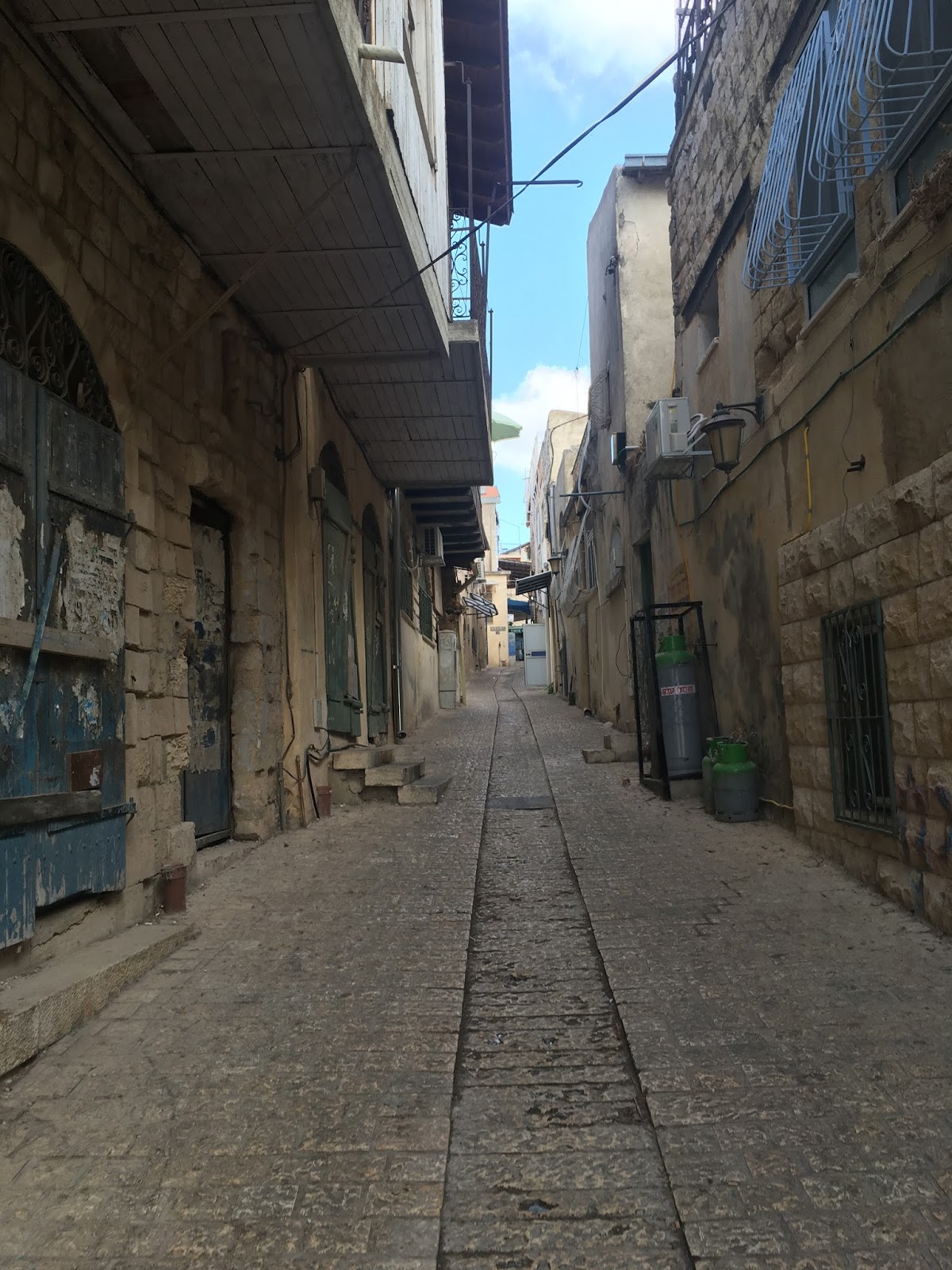
Narrow Streets in Safed, north of the Sea of Galilee
Narrow Old City street in Jerusalem with two Hasidics
Nice flowers around the entrance of where we stayed in Safed
We find a grocery store, it's got all kinds of bizarre food we've never seen before but one that we're very happy to see: hummus. We practically live off this stuff in the US and we've been dying for some and up until now it's been hard to find but Israel has hummus in spades. It is plentiful and it is good.
Looking down on the Sea of Galilee toward Capernaum from Mt Arbel
We get a good nights sleep and start out for Mt Arbel and it delivers on the promise of great views of Galilee. Its also the site of a 17th century fortress that hangs off the edge of the mountain and there is a pretty fantastic trail that takes you down the cliff and leads you through the fortress remnants.
Descending down the cliffs to check out the fortress ruins, Arab town of Hamam in the background
Another View from Mt. Arbel
Checking out the fortress
Looking up at the fortress on Mt. Arbel
The Sea of Galilee, beyond its history of Jesus Christ doing some fishing, is a bit of an oddity. It's fresh water, nothing odd there, but it's below sea level by 686 feet, which is unusual that it is lower than anywhere in the US by a huge margin. Galilee manages to be fresh by having an outflow, the Jordan River, which feeds the Dead Sea, which of course has to be even lower still. Its 1400 feet below sea level.
Down at the Sea of Galilee
The first Kibbutz, near Galilee, notice Hebrew, Arabic and Latin letters
Another interesting site near Galilee is the Deganya (or Degania) Alef Kibbutz. Its is a commune started in 1909 when the Turks still controlled the area. We didn't managed to get in because of their very limited hours but it's worth mentioning that Kibbutz's were a big part of Israel's early history. Many people were born on these communes and many still do live on them.
We left the Galilee area and checked out the Roman ruins at Caesaria, an ancient Roman capital on the Mediterranean. It's sort of half shopping mall and half Roman archaeological site. Good spot for a swim too. By now it's late afternoon on a Friday and shortly we get an introduction to a big part of Jewish culture: Shabbat. We're told that almost everything shuts down from a little before sundown Friday to a little after sundown Saturday, and they weren't kidding. Just on a whim we stock up on snacks before we take a cab to Jerusalem, and it's a good thing we did. When we get to Jerusalem everything is closed, the 24 hr market, fuel stations, super markets, everything. So we manage to live off snacks during Shabbat, namely peanuts.
The next morning I've arranged to meet a fellow airplane builder and get a ride in a plane just like mine. Private flying in Israel is a bit of a pain compared to the flying I do in the US. You have to notify the Israeli Air Force an hour before the flight and then check in every 5 minutes once airborne, it's a colossal pain compared to the US where I can legally fly from coast to coast and not tell a soul. Big thanks to my captain for persevering through all the adversity that is being a pilot in Israel. It is surreal to fly over Israel, a land that looks a lot like California deserts that I'm familiar with but is so different. Anyway, here are a few of the highlights:
The plane, an RV-8A
Over Mt. Masada which we hiked up later in the trip
Old City Jerusalem, complete with 2 Mosques.
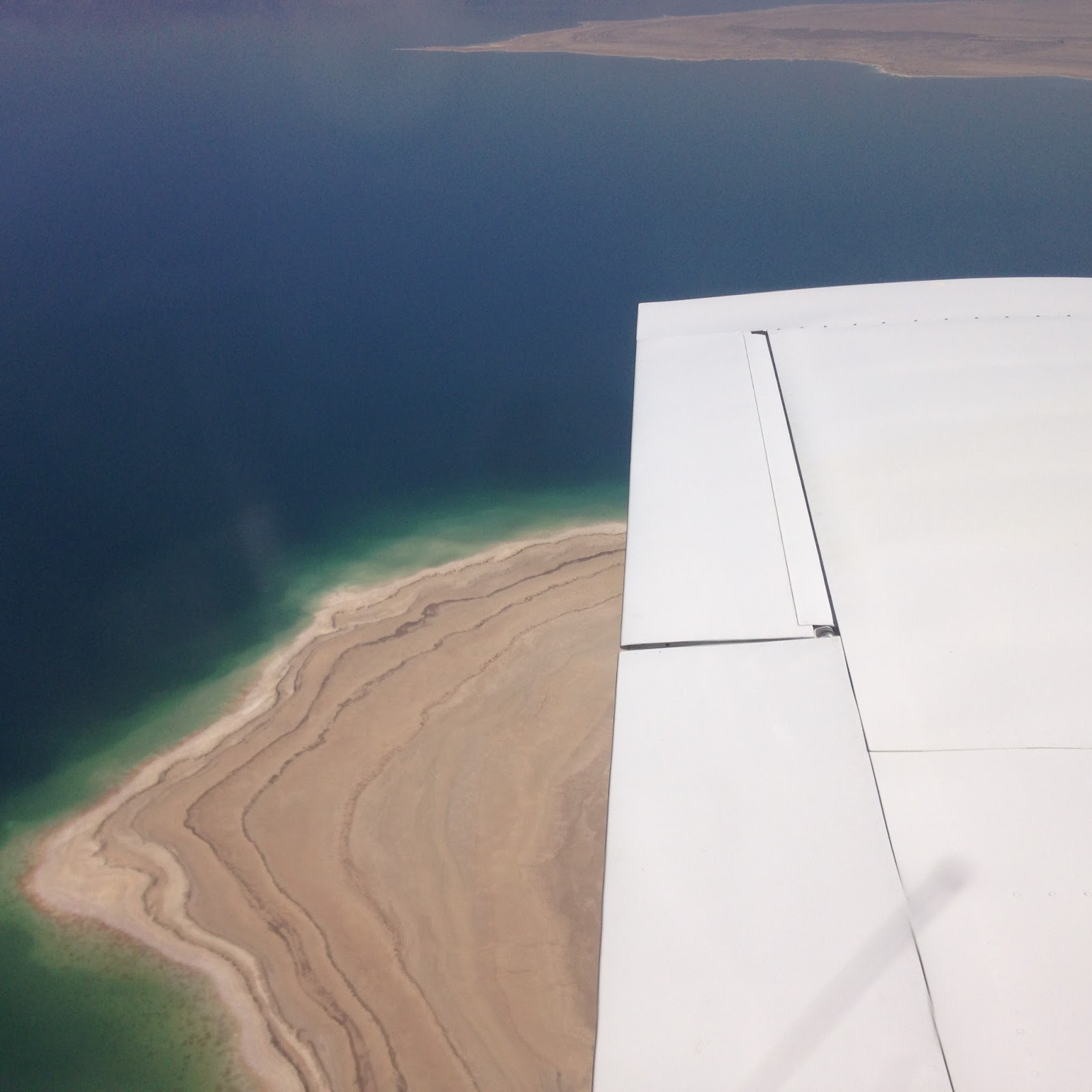
The edge of the Dead Sea, not far from where the Dead Sea Scrolls were found
More of the deadest of seas
Neat coloring along the briny edge
So while I got to go for an airplane ride on Shabbat, Kenzi was touring around the Old City of Jerusalem, not finding too much open. Meanwhile I learned is pretty much the entire rest of the country keeps on doing whatever it is they always do on Shabbat while Jerusalem strictly observes the day of rest.
What Jerusalem's Old City looks like during Shabbat
What Jerusalem's Old City looks like any other time
Israel's capital of Jerusalem is a sacred place for Jewish, Christian and Muslim faiths. The reason the city was initially founded there was the Gihon Spring which has provided water to Jerusalem since the beginning. They went through many gyrations to develop and make the water source secure. Initially they had a pool that would collect the water, then the city walls were extended to include the pool, and finally 2800 years ago, a 1750 foot tunnel was carved in the bedrock into a point low enough in the city to have what amounted to a city pool for gathering the water, doing laundry and bathing. It is an amazing feat of engineering, or labor at least. The Siloam Tunnel (aka Hezekiah's Tunnel) was started from opposite ends and the tunnel path is anything but straight. It's very plain to see that there was a lot of trial and error in figuring out how to make the ends meet.
The entry to the Siloam Tunnel
The best picture I could get inside the tunnel
The exit to the tunnel
The tunnel was actually just a side attraction to the City of David. Just outside of the 15th century walls of Jerusalem is where the original city stood and it dates back to the time of biblical Kind David and they believe that they have unearthed his house, although there is much debate so they just call it the "large stone structure" and leave it at that. In the excavation site they have found clay seals (much like wax seals) with names that match biblical characters so clearly this place has some history.
Potentially, maybe, could be, nobody is sure, but this could be the foundation of Biblical David's house
Not far from the City of David is the Western Wall, this was for many years called the "Wailing Wall" and now that term is considered derogatory. This is the closest that people of Jewish faith are allowed to get to the temple that was destroyed in 70 AD (the second biblical temple). It also happens to be the site where Islam's Muhammad allegedly ascended into heaven. As a result, there are two mosques on the site. The area where the mosques are is called the Temple Mount. Evidently the Torah (foundational Jewish document) forbids entering this area. The Israelis, being practical people, allow Muslims in to use their mosques and then put up a sign saying that the Jewish faith forbids it.
Admonition that the Jewish faith forbids entering the temple mount. We went in anyway.
Bar Mitzvah celebration we see while waiting in line to get into the Temple Mount
Mosque on the Temple Mount, don't get too close to someone of the opposite gender, you'll get yelled at
The Temple Mount is a very peaceful, beautiful place. We don't really know what we're looking at and so we wander around and try to be as respectful as we can. It's only open a few hours a day, the line is long and so we don't get too much time there.
Finally, the site that makes Jerusalem Holy for Christianity: the Church of the Holy Sepulchre, where allegedly Christ was crucified, buried, and resurrected. No less than six religious denominations have a claim on this Church and each has put in their own stylistic spin. It makes for a rather eclectic, anachronistic structure.
The best we could do for a picture of the outside of the Church of the Holy Sepulchre
Inside the Church of the Holy Sepulchre
Before leaving Jerusalem we also checked out the Israel Museum, a really fantastic collection of some one of a kind artifacts. I've already rambled too long here and so I'll only hit the highlights. This museum presented the best set of artifacts running from prehistory, as in before anybody was writing or recording things into the beginning of the Gregorian calendar. A lot of pre-history happened in Israel and around what is presently Israel and they've got various things to show for it. Eerie masks, the oldest sickle, examples of metal casting and in many cases the earliest known examples of each, all found right there in Israel.
Lost wax cast "Ibex Scepter" between 5500 and 6500 years old, and looks like its ready for a pagan procession!
Oldest sickle ever found, doesn't look so good
Creepy mask from 9000 years ago, still ready to scare the bejesus out of someone.
Silver scrolls containing a blessing in Hebrew from 6th or 7th century BCE
Move over Catholic Church, this is how the Romans actually crucified people
The actual evidence of how the Romans crucified people, complete with ankle bone and nail
The dome they keep the dead sea scrolls under made to look like the lid of the pottery they found them in
Lots of interesting stuff at the Israel Museum but alas we only had 5 hrs there... we could have easily stayed longer by they were closing. The next day we headed out of Jerusalem.
We wanted to hit up a few more places before we headed out of Israel. The major one was Masada, a mountain top fortress from 70 CE that was the site of the last stand for Jewish rebels during the revolt against the Romans. The story has it that when the Romans were about the breach the wall, the remaining hold outs all committed suicide, nearly 1000 according to legend.
To get to Masada we take a bus through the infamous "West Bank"(of the Jordan river). This is an area that was captured from Jordan during one of the many wars between Israel and its neighbors. Jordan pretty much completely accepts this and Israel controls it while the resident Palestinians are less than on board with that plan. Either way, our bus passed through the area with no issue whatsoever and dropped us back in Israel proper right at Masada. There are two ways you can get up Masada, cable car or walking.
We arrived a bit late to walk up the snake path and so rather than wimp out and take the cable car we decided to get on a bus and check out Ein Gedi, a literal desert oasis about 15 minutes north of Masada. Since it's the only source of fresh water for miles around, Ein Gedi has been quite the popular spot for millennia, for both animals like the ibex's we saw and people. Interestingly it's possible the people that hid the Dead Sea Scrolls lived in Ein Gedi, it is for sure where they found that ibex scepter we saw in the Israel Museum. So anyway we saddle up and check out Ein Gedi.
Ibex Selfie anyone? When there is only one water source there ends up being only one food source
Nice waterfalls
More nice waterfalls.
So Ein Gedi was pretty cool, like literally we got to cool off, there really isn't anywhere deep enough to swim but you can get wet anyway, which is welcome in 100 degree heat. We shuffle out of the nature preserve to catch the bus south to Ein Bokek to swim in the Dead Sea and find we just missed our bus by like 45 seconds... the next one isn't for 2 hrs. Not to worry, literally two minutes later a nice couple pulls up in their car asking us where you can swim in the Dead Sea... well let us hop in and show you where. We ride 30 minutes south and go to the public beach on the Dead Sea. Soon we're 1400 feet below sea level in hyper saline water that is 10x more salty and 22% denser than sea water. To put it mildly you float really well. The pictures don't do it justice but I'm sitting basically in a lotus position with my chest out of the water with out doing any work.
Look ma, no hands, feet or work!
Namaste here
So we bus it back to Masada and get to bed early as now we do the cliched sunrise over Masada hike. Not much to it, get up early and hike up the snake path. It takes us about 45 minutes. The sunrise is pretty spectacular, the site is sobering. You can see where the 8,000 Romans set up camps and built a siege ramp and wall to end the gambit of the 1000 or so Jewish hold outs.
Sunrise over Masada
The view looking west down on one of the Roman camps
The view looking east toward two more of the Roman Camps
Looking back at Mt. Masada
Our visit to Israel was packed with interesting stuff, with all the comforts of a country that has the highest standard of living in the Middle East. Many times we would forget even that we were in the Middle East at all. Our time was coming to a close, so we bused South and walked across the border into Jordan. Thanks for reading.
Correction: Jordan makes no current claim on the West Bank.
We've been traveling for a little over two months. At first it felt like a long vacation, but now it's really sunk in what an amazing thing this is. Yes, we've had our moments of museum overload, travel frustration, and tourist crowd fatigue, and I've had a bit more homesickness that I would have expected (Kenzi here), but we are LOVING having the time to learn lots of history, be outdoors walking a LOT, experience lots of new things, enjoy time together (feels a bit like a year-long date with Bill), and just really live. Thanks to all of you who have been following our travels for reading along and encouraging us. We so appreciate hearing from you, especially since we don't get a ton of longer interactions with other English speakers (aka it's a bit lonely).
Thanks for following our travels!
Here are a few day to day tidbits before I jump into the rest of our Greece travel:
Showers - Europe doesn't much seem to like shower heads or shower curtains. Well, they have shower heads, but they're not usually fixed to the shower wall, they're just hand-held. We find this different...and not quite as efficient.
Smoke - And while there aren't nearly as many overweight people here as in the US, there sure are a lot of smokers! I have inhaled more second hand smoke in the last two months than in my entire life combined.
Travel tip - When buying produce in much of Europe, you need to find the scale that spits out the stickers and put your sticker on your produce so the cashier will know how much to charge you. We have been incredibly fortunate so far that most of Europe speaks English.
Howdy! - We learn the basics in the local language (hello, thank you, etc), but they really take care of the rest.
Dryers - We do laundry regularly since we are traveling light. Much of Europe air dries clothes. You really gain an appreciation for clothes straight out of the dryer once you've had clothes line dried for awhile (especially towels!).
Greece has been the first country on our trip in which you can't always count on a toilet seat, or being able to flush toilet paper (just means you have to throw it in the trash instead). As for the Greek crisis, we've seen plenty of closed and abandoned buildings, plenty of trash in places it shouldn't be, and many idle shop owners in touristy towns bored from nothing to do and lack of visitors. However, if you didn't know there was a crisis, you wouldn't necessarily figure it out just by visiting. The EU has definitely poured money into Greece, which we benefited from multiple times as we drove on nice freeways, tunnels, and bridges.
With all our driving, we have seen lots of the Greek countryside including: mountains, sandy beaches, rocky beaches, bamboo, palm trees, pine trees, SOOO many olive trees(!), orange groves, MANY archaeological sites, and much more.
This is what an olive tree looks like. Their leaves area bit more green/gray or green/silver.
But my personal favorite was Meteora, which I had never heard of until we started researching where to visit in Greece. Meteora is an amazing place with surprising rock formations that look really out of place, and several of the rocks still have medieval monasteries atop the rocks. Wow! This place really knocked our socks off. We drove many hours out of our way to get there, so we were pretty bummed that it was raining when we arrived in Kalampaka, where we stayed. On an evening walk through Kalampaka in the rain, you could see the huge rocks just behind the town, but the tops were hidden by clouds.
Tops hidden in the clouds
Impressive rock formations
The next morning, it was still raining and the low clouds were still obscuring the tops of the rocks, but being the hopeful tourists that we are, we went ahead and drove to the monasteries in the hopes that it would clear up enough to see them. Only four of the six monasteries were open the day we went. We started by visiting the Roussenou monastery (which is now a thriving nunnery) first. We never really got to see the view from Roussenou because it was in the clouds, but we got to climb up to it and go inside. It was built in the mid-1500s as a monastery. It sustained some damage in WWII, but has been restored, and has a tiny lavishly decorated (but dark) Eastern Orthodox Church at the top (as do all of the monasteries). NOTE: Greece is 98% Greek Orthodox.
We climbed lots of stairs to reach this entrance to the Roussenou nunnery
The next monastery we visited was the Great Meteora, so called because it is the largest monastery remaining. It had a lavish Orthodox dark church as well (we weren't allowed to take pictures), but also had a museum with lots of interesting old medieval books and religious relics. It was built in the mid-1400s.
Grand Meteora looks pretty cool in the clouds
12th century Lectionary. Old books!
As we were leaving, the clouds were starting to clear and we were able to walk to a nearby perch and get some great photos of the Varlaam monastery, admire the incredible rocks, and wonder at how in the world those medieval monks were able to scale the rocks, let alone build structures on them, and feed themselves. Truly amazing! Once they got themselves up there and situated, they would bring other people and supplies up with a net on a pulley. Now all the monasteries are fairly easily accessible, several even have funiculars for handicapped folks who can't climb all the stairs.
Varlaam monastery. So cool!
In the mist, you can see the little cable car transporting a handicapped person
It's clearing up - yay! Some of the views around Meteora
Meteora views (you can see the town of Kalampaka peeking through the rocks)
We also visited the Holy Trinity Monastery and took pictures of the St. Stephen monastery. Needless to say this was one of the best experiences thus far on our trip, which is really saying a lot since we've seen so many incredible things.
St. Stephen monastery
Next, we traveled to Olympia, the home of the first Olympics in 776 BC. They were held every four years for about 1000 years until they were banned by Christian leaders because of their pagan history. Now Olympia is just a series of ruins, but we learned that the original Olympics were closely tied with religious ceremonies and sacrifices to Zeus. In fact, there was once a large temple there with a ~40 ft statue of Zeus inside, which is one of the Seven Wonders of the Ancient World.
Ruins in Olympia
An artist's rendering of what the giant statue of Zeus may have looked like
Ruins of the steps leading up to Zeus's temple in Olympia
The Olympic competitors had to arrive in Olympia a month early so that the judges (called Hellanodikai) could evaluate whether they were good enough to compete. The athletes were young men who were coached and selected for their strength, speed, agility, as well as their character and ethics. They competed naked, but smeared their skin with olive oil and sand, which acted like sunscreen. Instead of taking a bath after competition, they just used a scraper to get the oil and sand (and sweat) off. I just love imagining the smells back then (well, not really). The events included sprinting, long distance races, wrestling, boxing, chariot racing, pankration (combo of wrestling and boxing, where everything was permitted except biting and eye gouging - yikes!), long jump, javelin, discus, and racing in armor. Sadly, women were not allowed to compete; they weren't even allowed to enter the stadium to watch. Glad that's changed... The winners were given a crown made from a sacred olive branch to wear, as well as a statue of themselves in Olympia. Winners also enjoyed some lifelong privileges like never having to pay taxes, and getting the good seats at the theater and festivals.
On our drive from Olympia to Monemvasia, we stopped in Kardamyli for a quick lunch and some really nice views.
Kardamyli views
We had some amazing Greek salads in Greece, but this one was different and delish. Instead of olives, it had figs, yum! Bill had a fried pastry with cheese inside, also yum! And the best part - it was cheap. We ate well in Greece, for less money.
Next, we drove to Monemvasia. Monemvasia means one entrance. The ancient town is on a monolithic island rock, but it's difficult to see the town from the mainland. The island got separated from the mainland by an earthquake in 375 AD (yikes!) but now there's a road connecting them. The town and fortress were originally started in 583 AD. In spite of their nice fortress on the top of the rock, and the wall around the lower city, they have quite an interesting history of being conquered repeatedly by the Ottomans, and the Venetians, and back and forth. We hiked up to the top, which is mostly ruins of houses and the fortress, but there's also a pretty reconstructed church. We explored the lower town too, which is very small and has no less than 26(!) churches. By the way, Greece has LOTS of cats. As Bill mentioned in our last blog post, Athens used to have a stray dog problem. We don't know what happened to all the dogs, but they seem to have been replaced with cats.
Monemvasia
Monemvasia, from the start of our hike to the top
Looking back on the mainland from the top of Monemvasia island
Looking down on Monemvasia from the upper town
The ruins of the Upper Town on Monemvasia, including the restored church
On our drive from Monemvasia to Nafplio, we stopped at the ancient ruins of Mycenae, which we had learned about back in Athens at the Archaeological Museum. This place goes back even farther. The Mycenaean age is generally speaking from 1600-1100 BC. The ancient town has a really cool lion gate entrance, which is in remarkably good shape considering that it was never buried like most of the other ruins. There were two incredibly rich "grave circles", Grave Circle A and B, found at Mycenae filled with the kind of stuff that makes archaeologists swoon: pottery, jewelry, weapons, etc. They made no mention of bones, though, so we're not sure where the bodies were.
Us standing below the Lion Gate at Mycenae. The heads are missing. Archaeologists think they were made of different material.
Gold jewelry found at one of the grave circles at Mycenae. Seems to me like jewelry hasn't really changed that much in 3500 years...
Grave Circle A at Mycenae
Nice view of the Greek countryside from Mycenae, including rows of olive trees
The final stop on our grand tour of Greece and the Peloponnese was Nafplio, a bigger town by comparison, with a huge 17th century fortress on the top of the hill. We only had one night here, so we toured the fortress and took a refreshing dip in the water at the beach before heading back to Athens the next day.
The town of Napflio from the hilltop fortress
Just a small section of the very large hilltop fortress in Napflio
Beach in Napflio. You can see parts of the fortress at the top of the hill
We made it back to Athens without having crashed our car! Driving in foreign countries is no joke. Bill has done a great job. With one last half day in Athens, we toured the Panathenaic Stadium, which has been heavily restored since it was first built in the 4th century BC. It is the only stadium made of marble. It is where the "new" Olympics first took place in 1896. They also house the Olympic torches and all the modern Olympic posters.
Bill sitting in the "King's Seat" at the Panathenaic Stadium in Athens
The Panathenaic Stadium
The London 2012 Olympic poster and torch
The Panathenaic Stadium
Overall, we really liked Greece. Crisis Shmisis. Lots to see and do. Friendly people and cheap prices.
We are officially leaving the European continent, and things are bound to get even more interesting. So stay tuned.