Patagonia is one of those places that has a legendary aura to it... in my (Bill here) mind there are a bunch of ideas in people's brains around what Patagonia is. All of these camps could get their act together with a google search or two but alas here we are.
 |
| Hiking in Patagonia! |
 |
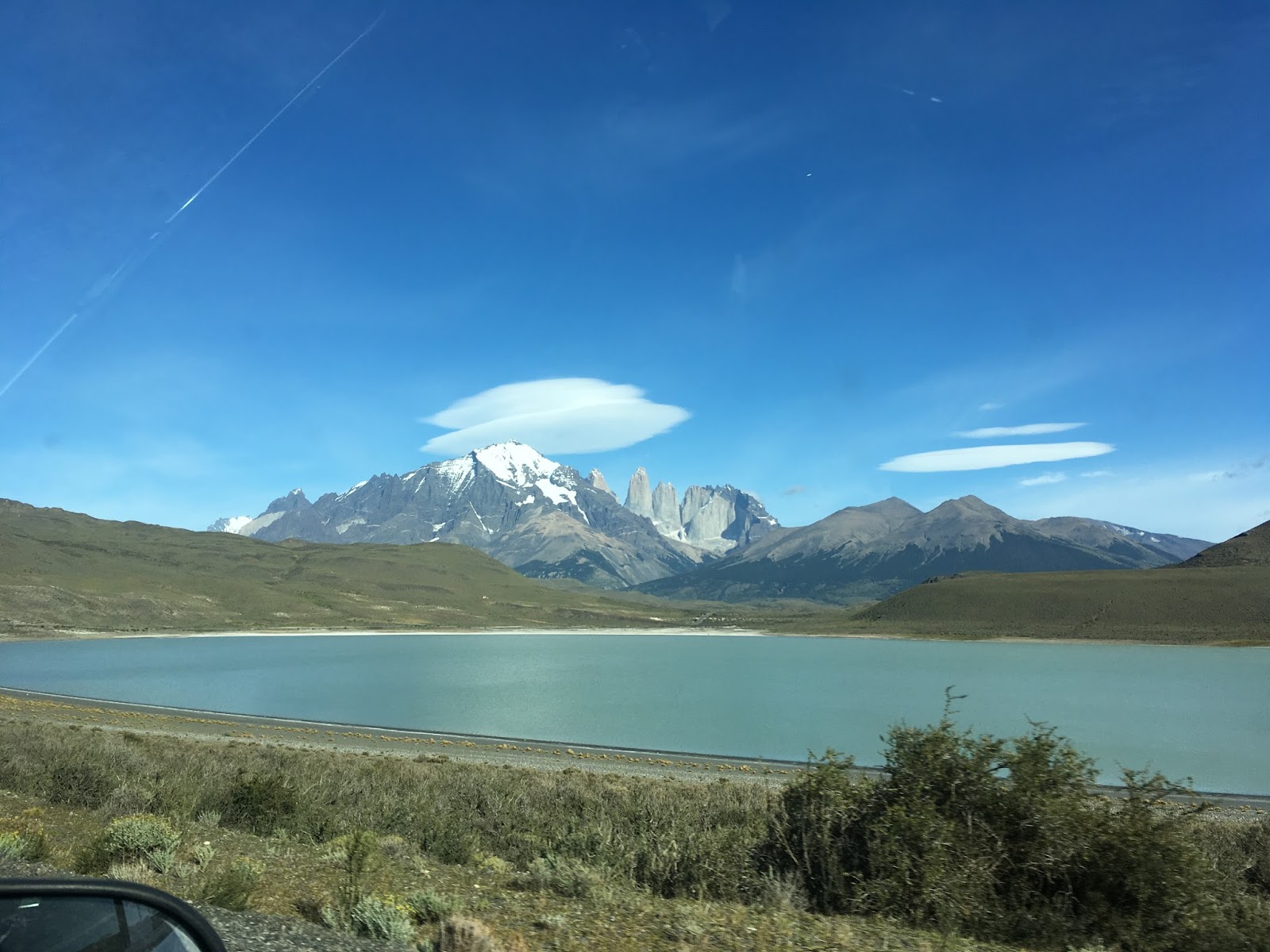
| Typical Patagonia landscape, Torres del Paine topped with Lenticular clouds (read: lots of wind!) |
There are some convinced that Patagonia is nothing beyond outdoor gear, others that are convinced its a mystical country of indefinite locale, perhaps unknowable locale, inhabited solely by scruffy hikers and climbers, when asked what continent, this group is dumbfounded. Finally there is a third, probably tiny group that realizes that Patagonia is a region of South America that includes parts of Chile and Argentina. Yes, there is a $600M/yr outdoor gear business with the same name, and cheerfully, that same business has done an extensive amount of conservation work in actual Patagonia, and that is laudable and is saving them from a lot of lambasting here.
 |
| Llago Nordenskiöld, a glacial Llke, in front of the "Cuernos" horns of Paine |
Anyhow, Patagonia is certainly the stuff of legends. Remote, sparsely populated, littered with mountains and glaciers, long harsh winters and short summers with great hiking. For outdoors types Patagonia has the best of it all, or at least that's the legend. Before I got here I was expecting that the ground would rise up and massage my feet and a choir of angels would sing as we set out hiking.
 |
| Typical Patagonian forest, very green, lots of trees broken and lying about from the brutal winter. |
Fantasies aside, Patagonia is pretty spectacular. First stop was Torres del Paine (pronounced pie-nay) National Park. At around 1000 square miles this park is roughly the size of the county I grew up in and has far fewer residents. The park has almost no paved roads, a few places to stay that are exorbitantly expensive, and some campgrounds that book up well in advance. We opted to stay about a 1.5 hrs drive south in Puerto Natales. This gave us the option to go to the park on good weather days and on crummy weather days drink warm tea in the "comfort" of our private room AirBnB/hostel.
 |
| Made a lot of tea in this poorly equipped kitchen... |
It didn't take very long to figure out that Chile is doing well economically so it's more expensive than a lot of places we have been and on top of that Patagonia has a very short season so an entire year's income has to be harvested from us tourists in just a few months. Because of all of this we ate most meals in.
 |
| Kitchen in the Hostel/Airbnb where we stayed |
But it was all worth it. The main attraction at Torres del Paine are granite towers (torres) that can be seen from various angles around the park but to really be appreciated you have to hike 5 hrs in. They are magnificent.
The geological formation is interesting as well, its called a
laccolith, This is a sort of volcano that never made it to the surface. Basically magma is injected up from far below and instead of making it to the surface it separates layers of stratified (usually sedimentary) rock. This forces the stratified rock up into a bubble like shape. The injected magma eventually cools, in this case into very hard granite. Fast forward a few hundred thousand years and erosion from water and ice removes a lot of but not all of the overlying sedimentary rock in the park. There are two major formations, the cuernos (horns) and the torres (towers). In the case of the towers all of the overlying sedimentary rock is removed and the much more durable and harder granite is left over. In the case of the horns the black overlying sedimentary rock is still very present and underneath the lighter granite is very visible.
 |
| Cold mountain stream coming down from the towers. From the laccolith formation notice the black rock overlying the grey granite in the upper left background |
Other interesting tidbits around the park are glaciers. Getting up close and personal with Grey Glacier involved an expensive boat ride and another long hike so we didn't do that but we did take a short hike along the associated Grey Lago (lake) where chunks of ice wash up and gradually melt.
 |
| Windswept beach along Lago Grey. |
Seeing ice formations is an interesting natural phenomenon that, from human perspective, lies somewhere between the completely static rock formations we see everywhere and completely fleeting glimpses of wildlife that we are only occasionally lucky enough to see. When I look at a rock face I know that it is changing every day but I don't expect to perceive any changes even if I come back in 10 years. We know in our brains that it's changing but our lives are just too short to see any sort of meaningful change except in a few cases like volcanic eruptions that are indeed very exciting and attract tremendous attention. On the other end of the spectrum, wildlife is almost always special to see. You never know where or what you'll see and it's almost always entertaining, you never really expect to see the same exact thing if you come back 10 years later. Ice, glaciers, occupy this odd middle ground, they are changing right before your eyes but seeing this takes patience.
 |
| Iceberg from Grey Glacier, which is barely visible in the back left. |
As we sat on the shore of Grey Lago the wind howled around us and occasional rain showers hid the sun. All the while, right in front of us was a huge chunk of ice from Grey Glacier easily the size of a building. As the light changed the color of the glacier changed. And, as if to punctuate its fleeting, dynamic character, while we were sitting there a chunk the size of a car fell off and made a tremendous thud. It was a cool experience, one that I know I won't have again if I go back.
 |
| Same picture as above but a few minutes later, notice the chunk missing from the left quarter just above the water line. |
This theme of the ice having its own sort of personality is repeated everywhere we see ice. Nearly the minute we get to the end of the hike to the towers we hear tremendous thundering, while we never saw any ice falling down from the glacier below the towers we were pretty sure that something was shifting in that smaller glacier.
 |
| So much rain here that the forest is covered in moss! |
Puerto Natales has a few other oddities. The mylodon is a sloth related animal that became extinct around when humans showed up. Incidentally this was the last land outside of Antarctica to be occupied by humans. Anyway, mylodon bones were found in some caves nearby and they figure that the animal was around 2 meters high/long, herbivorous, and walked slowly on all fours. Somehow the guy making the bronze sculpture at the edge of town didn't get that memo and so the bronze is more like 3 meters tall, viciously rearing up on it's hind legs, and other than the face, looking more bear like than sloth like but hey, you have to jazz things up somehow I suppose...
 |
| Does this look like a 2 meter long sloth like herbivore that walks on all fours? |
While it seems incredibly suspicious that this animal disappeared around when man showed up, especially given that it was related to slow moving sloths(read: easy pickings for well trained human hunters). Even given those thoughts the exhibits at the prehistoric caves were mum as to why the mylodon disappeared...
 |
| Puerto Natales is a maritime town, complete with abandoned ships. |
We are lucky enough to see quite a bit of wildlife. I have to think this has a lot to do with the conservation. Hunting is forbidden in many areas.
 |
| Guanaca! These guys (and gals) were everywhere munching on grass. |
 |
| A fox that wasn't having anything to do with posing. |
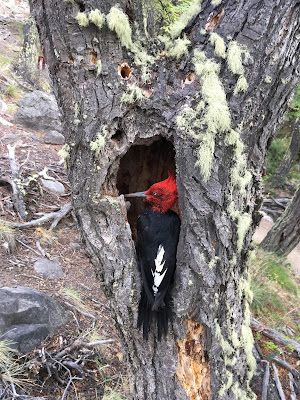 |
| Woodpecker being very cooperative with posing and not fleeing. |
 |
| Pygmy Owl behaving pretty well for the camera. |
 |
| Cows cowing. |
 |
| Sheep sheeping. |
The next major stop is El Calafate, Argentina, nearby the very active Perito Moreno glacier. This glacier is one of the few "steady state" glaciers in the world that isn't advancing or receding, it's terminus has generally been the same for about a century. Yes, surprise surprise, almost all glaciers are receding these days. The glacier is huge, about 3 miles across, 20 miles long and higher than 250 feet in some places. It moves about 6 feet each day, so when moving at that rate, with a steady state terminus... it has a ton of "calving" events, or where huge chunks of ice fall off. This happens randomly and we're lucky enough to see it but capturing it with a camera is another story, we didn't even really try.
 |
| Perito Moreno Glacier, more than 250 feet high behind us. |
Another curiosity of this glacier, because of the geometry of the terminus bisecting a lake, it usually blocks one end of the lake from draining into the other. This blockage can cause a difference in height of up to 75 feet. Eventually the pressure from that height of water is too much and it floats the ice blockage, water makes its way under the blockage, and an arch develops for the water to flow under, and then eventually the arch falls. This happens every one to ten years and they call it a rupture.
 |
| Pano of the glacier, notice the little tiny archway on the left, this is where the rupture happens. |
The next stop on the Southern Patagonia tour is El Chalten. El Chalten is a small town that is the gateway to a bunch of great hikes around the base of the Fitz Roy range. The town is on the east side of the Andes and so it benefits from a bit better weather because of the rain shadow. The profile of Fitz Roy and its surroundings might look familiar. It is the profile of the Patagonia outdoor wear logo.
 |
| Check this profile against your Patagonia jacket logo |
Hiking up to Fitz Roy is a reasonable all day affair. Bring a lunch and enjoy the views of glaciers along the way. On the way up it is cloudy but we once we get to the "top" (at least where you either have to stop walking or rope up to stay alive) once we get there, it clears off and we get to see the entire massif of Fitz Roy and it's surroundings. Between the Fitz Roy range and the view point there is the obligatory pale azure lake of glacier run off. It is, again, of course, totally matching the legendary air of Patagonia, completely amazing.
 |
| Fitz Roy is out of the frame way right, but anywhere you look is awesome, somehow I got stuck holding this rock up. |
The other hike we did out of El Chalten was to Cerro del Torre. Which, if you've been following closely is a tower like rock formation.
 |
| Cerro del Torre, impressive for sure, but after Fitz Roy? |
Cerro translates to "hill" but I think it means something more like "peak." The hike is easier than the hike to Fitz Roy. Cerro del Torre is spectacular in its own right but after seeing Fitz Roy it is a bit of let down. The obligatory lake isn't pale azure but muddy brown... and the peaks are impressive but compared to Fitz Roy... just not as impressive. If you go you would be well served to do Fitz Roy last.
 |
| The glacial valley is impressive though! Take from a lateral moraine, that, going left, bends around to a terminal moraine, and then bends back around into the opposite lateral moraine |
One really cool part of this hike is that you pass over at least three glacial moraines, where the glacier terminated for some period of time it dumped the debris that it eroded away from the valley it slid down. The hike ends on one terminal moraine and then we took the option to hike up one of the lateral moraines. Cool stuff for a geography geek.
 |
| Descending into the little town of El Chalten after the hike. |
From El Chalten we storm all the way back to Punta Arenas where we have a flight to the Northern end of Patagonia.
 |
| Ghost town on the Straits of Magellan |
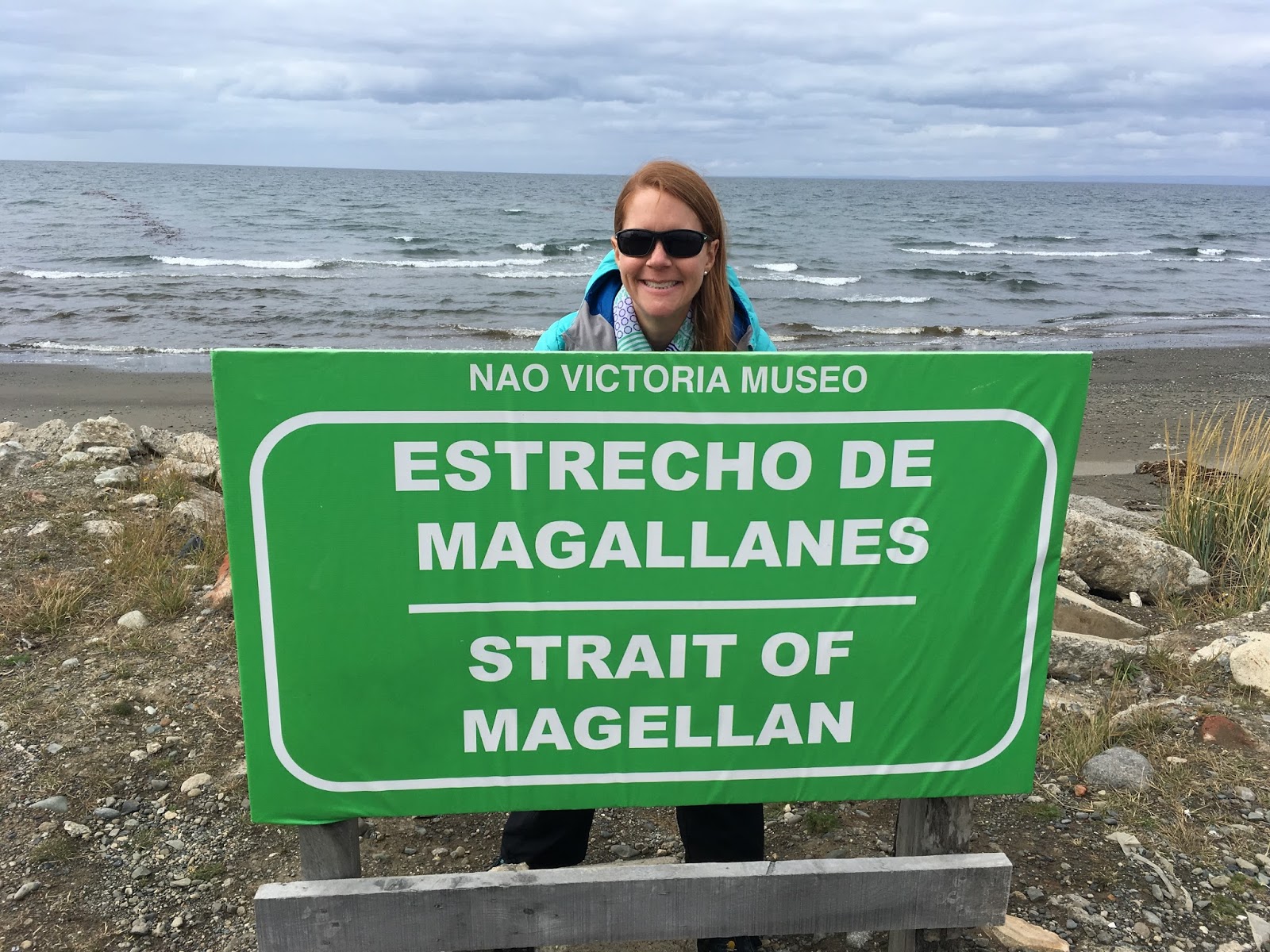
We end up with a few days on the Straits of Magellan in Punta Arenas which has some interesting history. Not only did Magellan pass through, Darwin's craft the Beagle happened through here, and Shackelton's rescued crew returned to civilization here. There was a maritime museum that made replicas of some of the ships involved in each voyage.
 |
| Replica of the Victoria, first ship to Circumnavigate the world, although Magellan himself didn't make it |
 |
| Replica of the Beagle, Darwin's Boat! |
 |
| Replica of the tiny 23 foot lifeboat the Shackleton navigated in horrible seas to save his crew |
 |
| Let me get this Strait... |
Thanks for reading.
Next up: Northern Patagonia